A new term has been gaining attention in healthcare revenue cycle discussions: intelligence-driven billing. Like many phrases introduced through industry conferences and technology vendors, it sounds important, but many practice managers are left wondering what it actually means for their day-to-day billing operations.
The answer is straightforward.
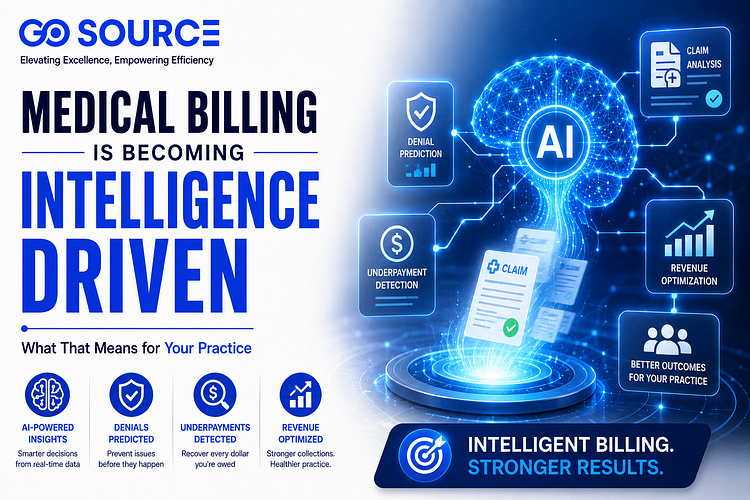
Intelligence driven billing means that revenue cycle decisions are guided by data and analysis rather than relying solely on individual experience or judgment. It helps practices identify which claims are most likely to be denied, which denials should be prioritized, which payers may be underpaying, and which documentation issues are causing the greatest revenue loss.
Instead of a biller deciding which denial to address first based on urgency alone, the system automatically identifies high value denials with the strongest chance of recovery. Instead of reviewing only a sample of claims, AI tools can detect documentation and coding mismatches before claims are submitted. Instead of discovering a payer payment issue months later, reporting systems can identify discrepancies much earlier.
This is not a future concept. It is already transforming medical billing today. The difference between practices using intelligence-driven billing and those relying on traditional approaches continues to grow with each passing month.
Curious whether cloud-based medical billing is right for your practice? Read More
What 'Intelligence-Driven Billing' Means in Practice
Intelligence driven billing is built on three connected capabilities that work together to improve financial performance.
Data Collection at Scale
Every stage of the revenue cycle generates valuable information. Eligibility verification results, claim submissions, payer remittances, denial codes, appeal outcomes, and patient payment trends all produce data that can be used to improve future performance.
An intelligence driven billing operation captures and organizes this information systematically instead of allowing it to remain buried within individual transactions.
Pattern Recognition Across the Data
Data alone does not create value. The real advantage comes from identifying meaningful patterns.
Using advanced analytics and AI-driven tools, billing teams can uncover trends that would be difficult to recognize through manual review alone. They can identify payers with rising denial rates for specific procedures, recurring documentation deficiencies, or scheduling practices that contribute to eligibility verification failures.
These insights allow practices to address problems before they become larger financial issues.
Action Based on Those Insights
Information only becomes valuable when it leads to action.
The final component of intelligence driven billing is using identified patterns to improve billing workflows. Rather than waiting for denials to arrive, practices can make corrections before claims are submitted. Instead of reacting to recurring problems, they can prevent those problems from occurring again.
Together, these three elements create a billing operation that continuously learns and improves. Traditional billing focuses on processing transactions. Intelligence-driven billing focuses on learning from every transaction.
Where Billing Intelligence Is Making the Biggest Difference
Predicting Claim Denials Before Submission
One of the most valuable applications of billing intelligence is identifying claims that are likely to be denied before they are submitted.
Machine learning models evaluate claims against historical payer behaviour, including frequently denied codes, documentation requirements, and common edit triggers. Claims that match high-risk patterns are flagged for review before submission.
As a result, issues that would normally be discovered weeks later through denials can be corrected immediately. First pass acceptance rates improve, denial-related rework decreases, and cash flow moves faster because claims are paid correctly the first time.
Identifying Underpayments Systematically
Payment errors occur more often than many practices realize.
Payers may apply incorrect fee schedules, bundle services improperly, or calculate patient responsibility inaccurately. Many billing operations simply post payments as received without verifying whether the reimbursement matches contractual expectations.
Intelligence-driven billing automatically compares each payment against contracted rates for the specific payer, plan, and service provided. Potential underpayments are flagged for review and recovery before they are finalised.
Over time, the revenue recovered through systematic underpayment detection can represent a substantial financial opportunity for many practices.
Prioritizing Denials by Financial Value
Traditional denial management often focuses on processing denials in the order they arrive or based on filing deadlines.
An intelligence-driven approach evaluates denials based on financial impact, likelihood of successful appeal, and remaining appeal timeframes. This allows billing teams to focus their efforts where recovery potential is highest.
For practices managing significant denial volumes, this strategy can improve net collection rates considerably. High value denials receive immediate attention, while low value claims can be handled more efficiently without consuming unnecessary resources.
Turning Billing Data Into Actionable Insights
Traditional billing systems generate reports that summarise performance metrics such as collections, denial rates, and accounts receivable ageing.
Intelligence-driven billing goes further by uncovering the reasons behind those numbers.
For example, instead of simply reporting a twelve percent denial rate, the system may reveal that most denials are coming from a handful of payer and procedure combinations. It may also identify the specific documentation issues driving those denials and suggest workflow changes that can significantly reduce future rejections.
This difference is important because insights lead directly to improvement, while reports simply describe what has already happened.
The Billing Intelligence Gap and What It Means
A noticeable performance gap is emerging between practices that have adopted intelligence driven billing and those that continue relying on traditional processes.
Practices using advanced billing intelligence tools are achieving first pass claim rates above ninety-five percent, while many organizations still operate within the seventy-five to eighty-five percent range. Denial rates are often below five percent compared with projected industry averages of fifteen to seventeen percent. Days in accounts receivable can remain below thirty-five compared with forty-five to sixty days for more manual operations.
These differences have a direct financial impact.
For a practice collecting two million dollars annually, the difference between a ninety five percent net collection rate and a ninety percent net collection rate can equal one hundred thousand dollars in additional annual revenue without adding a single new patient.
The gap continues to widen because intelligence driven billing improves over time. Each identified pattern strengthens future performance. Every payer specific rule built into the workflow reduces future denials. Every recovered underpayment improves future payment accuracy.
As the system learns from each billing cycle, performance becomes stronger and more consistent. Practices that continue relying on manual processes often struggle to keep pace because they lack the same continuous feedback and improvement loop.
How Practices Access Intelligence Driven Billing
Building intelligence-driven billing capabilities internally requires substantial investment. Practices need AI powered claim scrubbing tools, predictive analytics platforms, automated eligibility verification systems, payer specific rule management technology, and the expertise required to maintain and optimize these solutions.
For large health systems with significant resources and scale, that investment may make sense. For most independent practices and small physician groups, however, the cost and complexity can be difficult to justify.
As a result, many practices access these capabilities through a billing partner that has already invested in the technology and infrastructure required to support intelligence driven billing. By spreading those investments across multiple clients, billing partners make advanced revenue cycle capabilities accessible to practices of all sizes.
When evaluating a billing partner, performance metrics provide the clearest indication of whether they truly operate in an intelligence driven manner. First pass claim rates above ninety five percent, denial rates below five percent, and days in accounts receivable under thirty-five are strong indicators of an operation that effectively uses data and analytics to drive performance.
If a billing partner cannot demonstrate these outcomes, the technology they claim to use becomes far less important. Results remain the most meaningful measure of intelligence-driven billing.
The Takeaway
Intelligence driven medical billing is not simply a marketing term. It represents a measurable operational approach that separates high performing revenue cycle operations from those operating at average industry levels.
Practices that have embraced this model are collecting more revenue from the same patient volume, reducing the time spent managing billing issues, and building revenue cycle processes that continuously improve rather than becoming less effective as payer requirements evolve.
Practices that have not yet adopted intelligence driven billing are not necessarily underperforming. However, they are increasingly competing against organizations that can predict denial risks before claims are submitted, identify underpayments before they are finalized, and use billing data to guide strategic financial decisions.
GoSourceMD delivers intelligence driven medical billing through AI powered claim scrubbing, predictive denial analytics, systematic underpayment identification, and detailed performance reporting that transforms billing data into meaningful revenue insights every month.
FAQs
Q. What is the difference between AI assisted billing and intelligence driven billing?
AI assisted billing focuses on using artificial intelligence to automate specific tasks such as claim scrubbing, eligibility verification, and ERA posting.
Intelligence-driven billing takes a broader approach. It combines AI tools with data collection, pattern analysis, and workflow optimization to create ongoing performance improvements. While AI assisted billing focuses on automation, intelligence driven billing focuses on using information to make smarter operational decisions over time.
Q. Do I need to replace my EHR or practice management system to access intelligence driven billing?
In most cases, no.
Most intelligence driven billing solutions are designed to integrate with existing EHR and practice management systems rather than replace them. These tools work alongside your current infrastructure by collecting data, analysing performance patterns, and providing actionable insights that help improve billing outcomes.
Q. How do I know if my current billing operation is intelligence driven?
Start by asking a few important questions.
Does your team receive regular analysis identifying the denial causes responsible for the greatest revenue loss and recommendations for correcting them?
Are claims reviewed against payer specific denial trends before submission?
Are underpayments systematically identified and investigated before payments are finalized?
Is denial management prioritized based on financial value and likelihood of recovery rather than simply processing denials in the order they arrive?
If the answer to these questions is no or unclear, your billing operation is likely relying primarily on experience and manual decision making rather than intelligence driven processes.
Q. Is intelligence driven billing only accessible to large health systems?
Not anymore.
Large health systems were among the first organizations to build these capabilities internally because they had the resources to support significant technology investments. Today, specialized billing partners have made these capabilities accessible to practices of all sizes.
A small specialty practice working with an intelligence driven billing partner can often access many of the same analytical tools and performance advantages that large health systems developed through substantial internal investments.